


Dental implants in Nanaimo
A permanent replacement for a missing tooth: planned in 3D, placed with a surgical guide, and restored to look and work like the tooth it replaces.
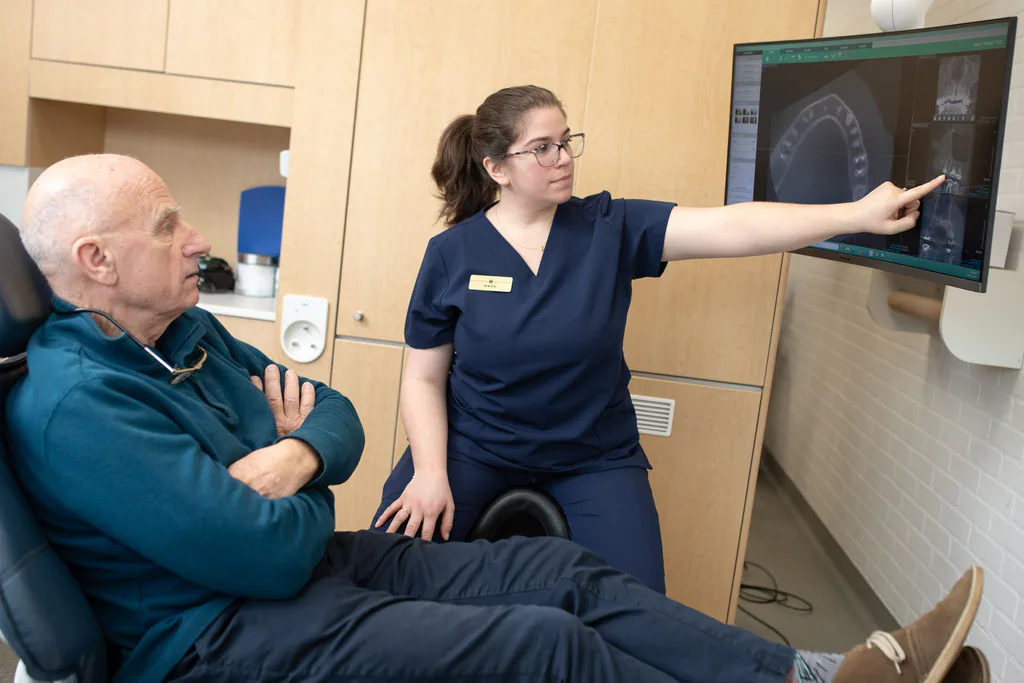
What is a dental implant?
A dental implant replaces the whole tooth, root included.
A small titanium post is placed into the jawbone where the root used to be. Over the following months the bone grows tightly around it, a process called osseointegration, until the post is anchored as securely as a natural root. A custom-made crown is then attached on top.
The result is a replacement tooth that stands on its own. It doesn't rely on the teeth beside it, it's cleaned like a natural tooth, and it doesn't come out.
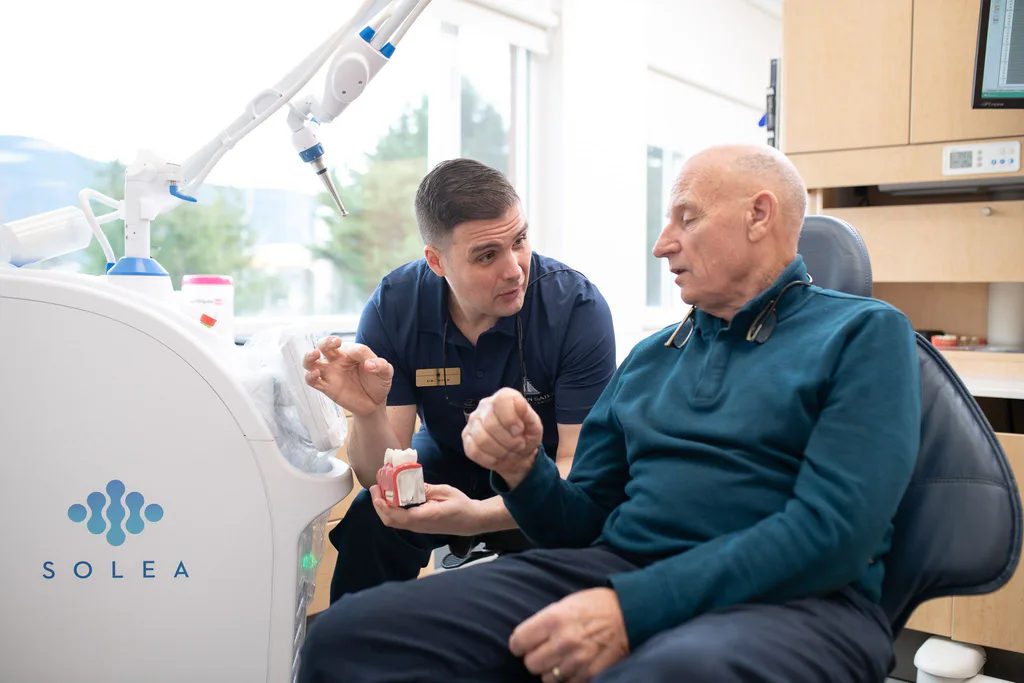
Why the root matters
The part of an implant most people never think about is the part that does the most work.
Jawbone keeps its density because it's being loaded: a root transmits the force of chewing into it. Remove the root and the bone beneath begins to resorb. Over the years that loss changes the shape of the jaw and the face, which is why long-term denture wearers often develop a collapsed look around the mouth.
An implant restores that loading. It's the only tooth replacement that preserves the bone underneath.
Am I a good candidate?
Most people are. The honest answer depends on three things, and we assess all three at a consultation.
Enough healthy bone
An implant needs bone to anchor into. A 3D scan tells us precisely how much you have and where. If there isn't enough, which is common where a tooth has been missing for years, bone grafting can rebuild it. We graft in-house, and it's a routine part of implant work rather than an obstacle to it.
Healthy gums
Active gum disease has to be treated before an implant is placed, because the process that damages the support around natural teeth will damage the support around an implant too. It's usually a matter of a few months of periodontal treatment rather than a disqualification.
General health and habits
Well-controlled diabetes, most medications and most medical histories are entirely compatible with implant treatment. Smoking measurably reduces success rates, and we'll talk frankly with you about it. Certain medications, particularly some bone medications, need discussion first.
What about age?
There's no upper age limit. The only firm restriction is at the other end: implants aren't placed until jaw growth is complete, generally in the late teens or early twenties.
Restoring how it looks, and how it works
Function
An implant restores close to the full bite force of a natural tooth. Steak, apples, corn, crusty bread: the foods people quietly stop ordering after losing a molar all come back. It also stops neighbouring teeth drifting into the gap, which is what turns one missing tooth into a bite problem over time. And unlike a partial denture, there's nothing to take out, nothing to click, and nothing to think about at dinner.
Aesthetics
The crown is designed digitally and matched to the shade, translucency, shape and wear of your surrounding teeth. In the front of the mouth we also shape the gum tissue around the implant, so the restoration emerges from the gumline the way a natural tooth does. That's usually the detail that separates a good implant from an invisible one.
Longevity
With good hygiene and regular maintenance, implants are the longest-lasting tooth replacement available. The post itself is designed to be permanent. The crown on top may need replacing after many years of ordinary wear, as any restoration eventually does.
What the process looks like
Consultation and 3D planning
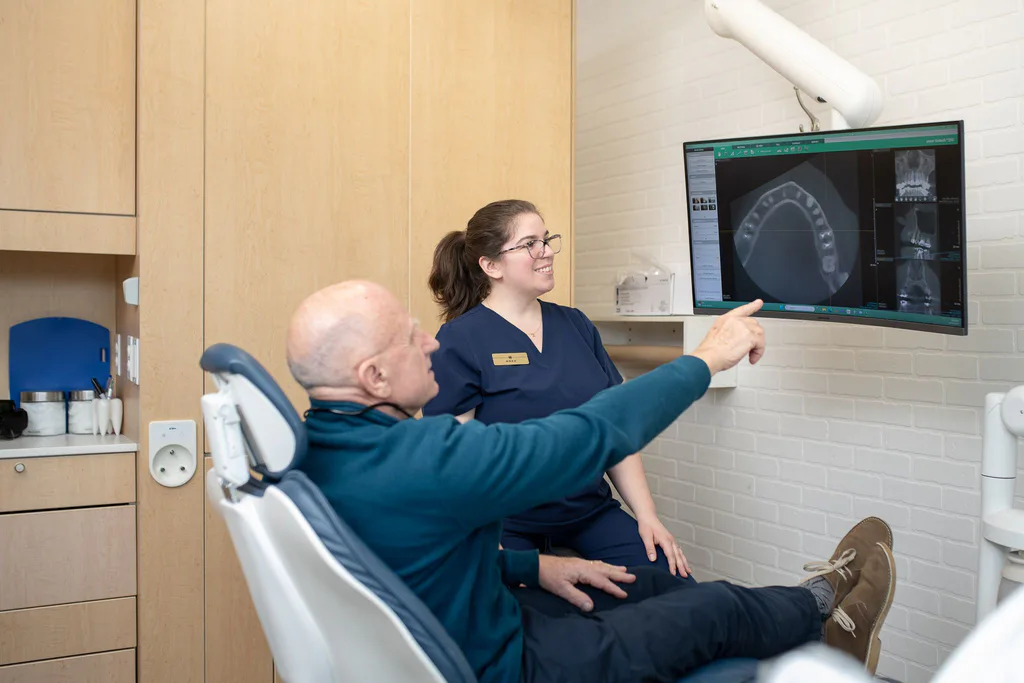
A full assessment, a 3D scan, and a conversation about options, including the ones that aren't implants. If an implant is right, we plan the exact position, angle and depth digitally before any treatment begins, and give you a written treatment plan with costs.
Grafting, if needed
Where bone volume is insufficient, we graft and allow it to heal. PRF prepared from your own blood is used to support healing.
Guided placement
The implant is placed through a custom surgical guide built from your 3D plan, so the placement matches the plan precisely. It's a shorter, less invasive appointment than most people expect, done under local anaesthetic.
Healing
Three to six months while the bone integrates with the implant. You'll have a temporary restoration during this time, so you won't be walking around with a gap.
The final restoration
Your permanent crown is designed, produced and fitted. This is the appointment where it stops being a treatment and becomes a tooth.
More than one tooth
Multiple implants
Several missing teeth can each be replaced individually, or two implants can support a bridge spanning a longer gap.
Implant-supported dentures
For patients missing most or all of their teeth, a small number of implants can anchor a full denture. That eliminates movement, adhesive and the pressure sores that come with a conventional plate, and restores most of the bite force of natural teeth.
What implants cost
Implant treatment is priced individually, because the work varies: whether grafting is needed, how many implants, and the type of restoration.
What we will commit to is this: you'll receive a written treatment plan with itemised costs before anything begins, and we'll submit a pre-determination to your insurer so you know what they'll cover. There are no surprises at the desk afterwards.
We're also happy to weigh the cost against the alternatives. An implant is usually the most expensive option at the outset and the least expensive over twenty years. Whether that trade-off is right for you is your decision, and we'll give you what you need to make it.
Common questions about dental implants
Placement is done under local anaesthetic, and most patients describe it as more comfortable than an extraction. Any discomfort afterwards is usually managed with over-the-counter pain relief for a few days.
Typically four to nine months from placement to final crown, most of which is healing time rather than appointments. Grafting adds several months.
With good maintenance, decades. Long-term studies consistently report success rates above 95%.
That's the standard we design to. In the front of the mouth, it's the whole job.
Coverage varies considerably. We submit a pre-determination to your insurer before treatment, so you know your exact out-of-pocket cost in advance.
Usually, yes, though some bone will likely have been lost in that time and grafting may be needed. A 3D scan gives us the answer in one appointment.